Curbside Composting in Kitsap
Curbside compost service is available to residents in Kitsap County. Contact the service provider in your area to sign up. Find out what items go in your food and yard waste cart with our curbside compost guide (PDF).
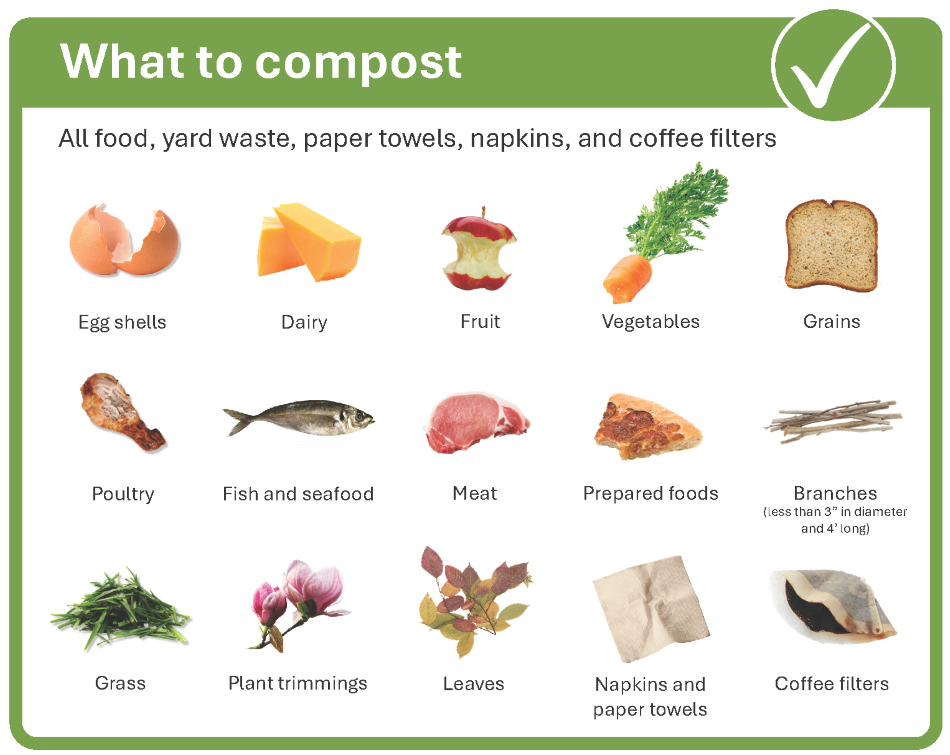
Residential curbside composting guide
Accepted items include:
-
Yard waste (leaves, grass, plant trimmings, and branches less than 3" wide and 4' long)
-
Food (including raw, bones, and prepared)
-
Food soiled paper (paper towels, napkins, and coffee filters)
-
Paper bags or BPI certified bags
Not accepted:
No plastic bags, including those marked "compostable/biodegradable/degradable." Only use paper bags or
BPI certified bags. Learn more about Washington’s
compostable plastic labeling requirements.
No dirt or rocks
No produce stickers
or food labels
No glass, plastic, or metal
No
noxious weeds. Place these in the garbage.
No diapers or pet waste. Place these in the garbage.
No fats or oils
No take-out containers, including packaging labeled as "compostable" or certified as BPI compostable
No cigarette butts
No dryer lint
Common questions
Why should I put food waste into my yard waste cart?
Composting can save money.
Putting food scraps, yard waste, and food-soiled paper in the food and yard waste cart generates less garbage. With less garbage, you can opt for a smaller (and cheaper) garbage service level.
Composting helps the climate and conserves resources.
Composting helps the climate and conserves resources.
-
Food in the landfill breaks down very slowly and emits methane, a powerful greenhouse gas.
-
Landfills are the
third largest source of human-related methane emissions in the U.S.
-
Composting reduces landfill waste by approximately 25%.
-
Garbage from Kitsap County travels over 300 miles to Oregon, while composting is done locally on the Kitsap Peninsula.
Compost enriches soil.
-
The process of breaking down food and yard waste produces compost, a nutrient-rich fertilizer.
-
Composting returns nutrients to the soil. Learn how Kitsap County uses
compost in county projects.
How do I get my food waste from my kitchen to my yard?
Find a system to collect food waste that works for you and your family. A few options include:
Use a brown paper bag to collect scraps. Once full, place the bag and scraps in the yard waste cart.
Tip: keep it in the freezer to reduce smells.
Repurpose an existing container as a kitchen collection bin.
Do I have to participate?
Participation is optional. Washington State is committed to reducing landfill-disposed organic material by 75% by 2030. By 2025, edible food disposed in landfills must be reduced by 20%.
Kitsap County is proactively implementing the state’s organics laws, including Washington State House Bill 1799. This law requires Kitsap County to offer food and yard waste collection services to all residential customers, except multifamily residences, by April 1, 2027.
What happens to the collected food and yard waste?
Won't putting food waste in my yard waste cart attract pests?
Food waste has been safely collected in yard waste bins in neighboring communities and across the country for over a decade. Mixing food waste with yard waste in layers in your cart helps reduce pest issues.
Will fruit flies be an issue?
-
Empty your kitchen scrap container into the yard waste cart several times a week.
-
Use a BPI-certified compostable bag or paper bag to line your kitchen pail.
-
Wash your kitchen food scrap container regularly.
-
Sprinkle baking soda over scraps or wrap them in newspaper to absorb odor and liquid.
-
Store the container in the refrigerator or freezer during hot weather.